The Battle of Narnaul: Re-examining the 1857 rebellion and selective memory
The Battle of Narnaul
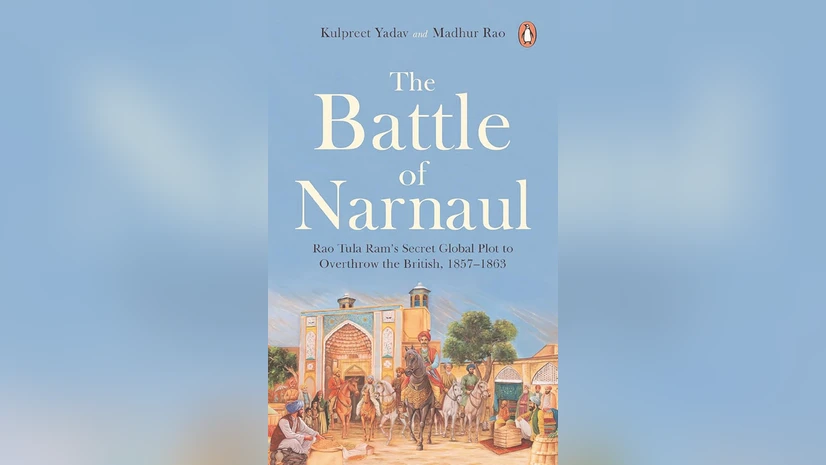
We Indians are a study in contradiction. We remember selectively, forgive conveniently, and are culturally conditioned to avert our gaze from inconvenient truths. We lionise freedom fighters, yet uncritically revere the royal lineages that helped crush the 1857 uprising. The book ‘The Battle of Narnaul’ weaves threads into a compelling story of Rao Tula Ram & his gallant colleagues at the Nasibpur ka Yudh, which was a part of the uprising of 1857, popularly remembered as India’s 1st war of independence.
Even though the book does not intend to; but one cannot be spellbound by the betrayal of the ruling principalities of the times. Principalities like of Patiala, Jodhpur, Bikaner and Jind chose to side with East India Company against rebels who wanted to remove the yoke of company dominion over the sub-continent.
One of the most unsettling truths of Indian colonial history that the book brings out is not merely that a foreign power ruled the subcontinent, but that Indians were repeatedly deployed to suppress Indian resistance to that rule. Books on historical characters tend to be patronizing to the protagonist, this one is no exception. The authors use historical research and have written the book in a narrative nonfiction style to make it engaging.
When the 1st war of independence ended in 1857; those who resisted the East India company were executed and dispossessed. These included Rao Tula Ram of Rewari, Nawab Abdur Rahman Khan of Jhajjar, Raja Nahar Singh of Ballabgarh, and same was the fate of the Jats of Panipat and Rohtak or the Gujjars and Mewattis in Gurgaon and many more. Others, who were politically astute, by accepting the authority of the East India Company and later the British Crown, were assured of titles, territories, and dominion protection to quell rebellions that arose from within their kingdoms. While the compliant were preserved in memory as rulers and statesmen; the defiant were reduced to footnotes, martyrs at best, rebels at worst. History, as ever, was written by those who lived long enough—and prospered enough—to commission it. Against this grain; the book’s attempt to recover the story of the martyred Rao Tula Ram is notable.
The narrative also reiterates an inconvenient truth often blurred today: religion was not the animating force of the freedom struggle. The battle for India’s independence was fought under the banner of Bhadhur shah Zafar, the last Mughal Emperor of India. This was nothing new; the princes never had qualms about forging allegiances to stay in power; 27 marriages are recorded of Rajput royals and the Mughals or them accepting the vassalage of the Christians. Loyalty in colonial India was rarely moral or ideological; it was transactional.
With the fall of Delhi on 21 September 1857, and with principalities bordering Narnaul like the Maharaja Sawai Ram Singh II of Jaipur, Rao Raja of Alwar, the Thakurs of Shekhawati, the Nawabs of Pataudi and Loharu aligning themselves with the East India Company, the Battle of Narnaul on 16 November was effectively a lost cause. With their help the East India company could bring unparalleled reinforcements to bear down on the isolated Rao Tula Ram. In spite of the odds stacked against him, the valiant Rao Tula Ram fought with tactical clarity against overwhelming odds. Courage could not overcome superior firepower, politics, and betrayal.
Narnaul was no Panipat; it was not a clash of imperial armies numbering in the hundreds of thousands, but a battle between smaller bands of a few thousand men. The rebels, armed with outdated rifles and limited ammunition, faced a disciplined, well-supplied force with superior firepower. Another issue, however, remains under-examined: did the masses truly rise, or was the rebellion largely confined to mutinous soldiers and defiant princes? Popular participation—the true test of revolution—remains ambiguous. The counterfactual remains uncomfortable. Had the rebels prevailed; would the subcontinent with its 560 odd kingdoms still be fractured into warring principalities?
Rao Tula Ram, young but visionary, dared to dream of freedom, planned for it, and travelled great distances in hostile circumstances seeking alliances beyond the sub-continent with Persia and Russia. After six years in exile, he died chasing a chimera at thirty-eight in Afghanistan in 1863. And memory, like power, followed the winners. His story reminds us of a sobering truth, that the most effective domination is not imposed from outside, but enforced from within. The book is an invitation to rediscover a moment of defiance and shed light on forgotten heroes whose sacrifice deserves recognition.